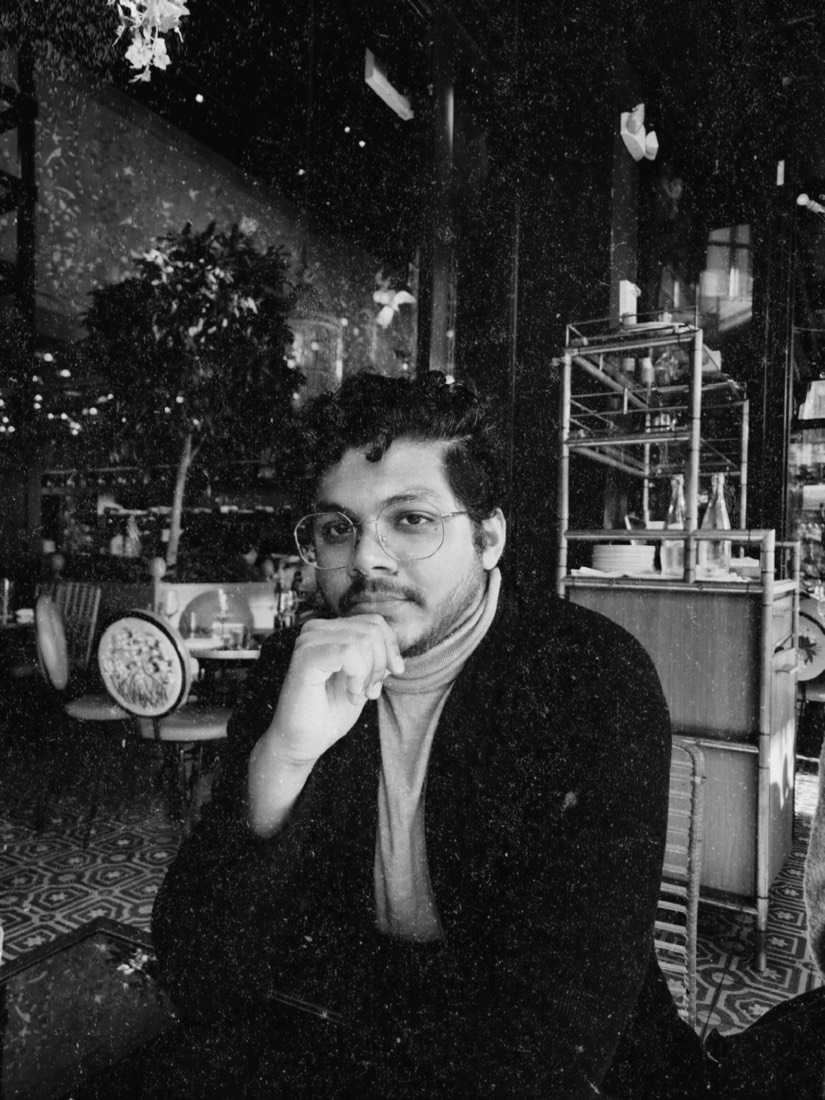
I study how light and matter conspire in atomically thin crystals — twisting two-dimensional materials into new phases of quantum matter in Prof. Hafezi's group at the University of Maryland, College Park.
Are you sure you're at the right place? If yes — you're someone with an inquisitive, research-oriented mind. Welcome.
I am Pranshoo Upadhyay, an ardent lover of physics with a B.Tech. in Electronics and Communication Engineering — now pursuing a Ph.D. (Fall 2022) in quantum science and technology at the University of Maryland, College Park.
I work in Prof. Hafezi's group, affiliated with the Joint Quantum Institute (JQI), the Quantum Technology Center (QTC), QuICS, and IREAP. My current interest is to explore novel light-induced quantum phases in TMD heterostructures, in both the bosonic and the fermionic regimes.
To reach what I crave, I dig into nanoscale interactions — a sea of quasiparticles: excitons, polaritons, magnons, phonons, skyrmions. It's a long journey ahead, and I hope to meet, discuss, and work with inquisitive, analytical minds along the way.
"Never say no to a possibility until you can prove, without any assumptions, that it can never happen."A rule I work by
Ph.D., quantum science & technology — light-induced quantum phases in TMD heterostructures, Hafezi group (JQI · QTC · QuICS · IREAP).
Project Associate with Dr. Pramoda K. Nayak at 2DMRI — topological-insulator heterostructures, thermoelectricity and excitonics in TMDs, hybrid hetero-systems.
B.Tech., Electronics & Communication Engineering — designed and modelled hybrid steep-slope FETs for low-power, high-speed applications with Prof. Pravin Kondekar's group.
The most interesting physics lives where particles can no longer be treated as independent. My methods are optical; my questions are many-body. Four threads, one fabric.
Physics is the day job and the standard of proof. These two are open questions I think about after hours — held to the same honesty, clearly labelled as conjecture.
A developing, deliberately unfinished idea: the mind is built on quantum systems, but consciousness may be a universal field the mind couples to — with "soul" as the quasiparticle of that interaction.
Can consciousness be defined within quantum theory? My intuition says it may — but it would demand rigorous modification, and a physical understanding of QFT that is currently lacking. Unlike most quantum-mind theories, my initial analysis suggests the mind is definitely built upon quantum systems, yet does not generate consciousness. Rather, consciousness is a field present throughout the universe that our minds access. This newborn theory even has room to address free will and qualia. Whether the approach is dualistic or monistic depends on what you mean by consciousness.
Two great traditions divide the literature. In the dualist line: Samkhya philosophy (pure consciousness, Purusa, separate from Prakriti — matter, including mind), Dvaita Vedanta, and Descartes' mind–body duality. In the monist line: Advaita Vedanta (only brahman, as in the Mandukya Upanishad), materialism (brain interactions create everything), and quantum theories of mind — most famously the Orch OR theory of Penrose & Hameroff, built on quantum processes in neuronal microtubules. Lately, many scientists have drifted toward panpsychism: everything is conscious, and emergent consciousness of life can be studied from conscious elementary constituents.
Questions like "how reddish is the red?" mislead the notion. Awareness of surroundings is something our individual minds, created by our brains, can handle. Note that everything around us is, at bottom, a field — matter fields, EM fields — and quantum theory makes it all probabilistic. That is where consciousness enters: the fundamental entity that sources life, defines the future, connects minds, makes dreaming possible. It is not the waking state. Neuroscientists can switch specific feelings on and off by stimulating points in the brain — but tampering with a circuit component doesn't make that component the power supply. The circuit still runs on something.
A particle has mass only by interacting with the Higgs field; photons and gluons opt out and stay massless. Similarly, it could be a conscious field that minds interact with to gain access to reality. From QFT we know every distinct interaction births a distinct quasiparticle — phonons, plasmons, magnons. "Soul" could be the quasiparticle of the mind–consciousness interaction. Mind, body, soul, thoughts, decisions, experiences: personal. Consciousness: universal. And as nanoscale interactions need the right conditions to strengthen, the mind–field coupling has its own favorable conditions — what Vedanta and Buddhism describe as accessing levels of consciousness through yoga, meditation, and lifestyle. In a coma, the coupling is weak and the world fades; at death, the mind loses the power to couple at all.
A note on this theory: what you've read is the gist of a building idea that needs heavy mathematical and experimental proof. Sticking to personal opinion is not how science is dealt with — I am open to modifications and corrections, and I'd genuinely enjoy hearing your views. Write to me.
Reading body language, facial expressions, eye and hand movements, and vocal variation together — to notice what is actually going on in a person's head.
Strictly speaking, I have limited command of the technical vocabulary of this vast field — yet it remains one of the most interesting areas for me. Observing posture, expression, eye movement, and vocal variation collectively tells you a great deal; this habit served me well when I worked in the counseling service at IIIT Jabalpur, talking my juniors through rough patches.
Two threads hold my attention:
1 · Channeling an intensified emotion. Sorrow, anger, depression, loneliness — states that consume a person can, with care, be redirected into something constructive. The energy is real; only the vector is wrong.
2 · Finding the origin of strong perceptions. Digging to the root of a powerful thought or belief — what actually planted it — rather than arguing with its leaves.
Learning physics in its true form — back to the first works.
This is my journal club: I dig into the history of each phenomenon and try to revive its true meaning — tracing it back to the first works, restoring the forgotten hands the textbooks dropped, and calling out the conflations the literature quietly absorbed.
Every dossier is researched and written by AETHER — a research-observatory app I built myself (thanks to Claude).
Enter the Observatory →Nine peer-reviewed volumes and counting. Pull one off the shelf — each opens to its figure and abstract. The full catalogue lives on Google Scholar.
Sharing what I know — a genuine description of what goes into a Ph.D. application, written for the student I used to be.
Hello there! I am someone with a B.Tech degree in ECE from IIIT Jabalpur, India (assign whatever tier you like). It is an institute much better than most government institutes in India, including several NITs (except the top 3 or 4) and other IIITs — better in terms of research, which is what this page is all about. But as we all know, in India there is a tremendous gap between the IITs/IISc and the rest in terms of everything: funding, connectivity, international opportunities, research, intensity of courses, reputation, and whatever else you could think of. The only factor that can truly hold someone back, though, is an environment with no research motivation.
So, coming to the point: I have no international research experience (Covid killed it), nor any recommender who is highly recognized in my field (no offense, but it's true). What I do have is highly reputed publications, experience in varied fields of research, and a research position at IIT Madras after my B.Tech. With these things — and the five P's of life — I received Ph.D. offers from 3 reputed places (UMD, UW Seattle, and Purdue) out of just 6 applications (that low number has a sad story of its own related to my institute, but let's not get into it).
During my journey I had literally no one around to guide me through most parts: how to begin research, whom to approach, what and when to learn, which research-based internship programs exist for undergrads, the difficulties of the application process, how to approach faculty, where and when to search for internships, how to analyze the right groups… I did it all by myself. I spent over 2 years tabulating interesting groups, universities, and programs, and months during my second year hunting every internship program I could apply for — often discovering them after their deadlines had passed.
It was a great struggle, but I firmly believe those struggles make you strong, aware, and independent. So I want to help others — but not spoon-feed them. My only aim is that future applicants do not suffer from a lack of information, or waste their valuable time on unnecessary things.
So here you are, trying to find the right path toward becoming a researcher. From what I have experienced and observed, dividing your four academic years into the following stages will prove advantageous. Click each year to expand.
This is the year of transition from school life to college life, and you will take some time to adjust. Do not worry about your far future now — just don't. Trust me, I have always been the person who plans several years ahead, but it will not help in your first year. Relax, make friends (good ones; don't get carried away by the crap around you), and most importantly, focus on every single course in the curriculum. The first-year courses are the fundamentals — never neglect them or you will regret it while taking advanced courses later (plan those now). Learn as many things as you can and do not restrict yourself to one topic at this stage. Find out which software and tools your stream uses, and learn them. Above all, learn how to write a proper mail — something the majority of students need to work on. Be the receiver. Grow.
Now is the time to try several sub-fields within your domain of interest. My domain was ECE: I chose projects in image processing and ML-enabled electronic systems, robotics, embedded systems, nanoelectronics, laser-based devices, and plasmonics. Although I had been sure of my true interest since school days, I practically did something in all of these — to be certain, and to make sure I would never regret not having tried other things. When you try different things, you not only learn which one interests you most; you also learn to connect ideas across fields, something many researchers lack.
Do a summer internship in a related field if possible. There are many opportunities at premier institutes in India (VSRP, ICTS, IITs, SRFP, CeNSE), Austria (IST), Japan (OIST), Singapore (NTU/NUS), Taiwan (TEEP, TIGP), Saudi Arabia (KAUST), and other open programs (MITACS, Charpak, CERN, S.N. Bose program, etc.). And remember: by this time you must also make yourself known to the professors with whom you'd want to do a mini research project. Be the jack of all trades. Expand.
By this time you must be aware of the topics that interest you. It need not be very specific — actually, it should not be. For instance, I knew I wanted to work at the fusion of condensed matter physics and photonics, and I began research at the end of my sophomore year on a topic available in my group back then. This year is for learning the whys and hows of graduate research, knowing what it takes to be a researcher, and strengthening your mind before you enter that phase of life. Also: start preparing for the GRE and TOEFL and get rid of them. Finally, begin preparing a list of groups where you would like to apply for your Ph.D. — just make the list; it will be nowhere close to your final one. Be a seeker. Learn.
This is a hectic year; you will have no time to waste — and if you do waste it, sorry, you are rejected! Before even entering senior year, if your college allows it, go for research internships during the summer break — preferably at a research institute, not a company. It is the time to work, work, and connect. Keep mailing professors for semester-long research internships. Never lose hope. Never compare yourself to anyone else — it is the worst thing you could do to yourself. If you are from an institute like mine with no great recognition, you will have to make more effort: your mails will go unnoticed most of the time, with no reply 90% of the time. But you only need one positive reply, my friend. Just one. The same holds when you apply for Ph.D. positions.
For details on how to apply, see Note 03 below. Finally — always have a solid backup plan at every step, analyze the assumptions behind every decision, and never rely on your friends in this matter. Be persistent. Resolute.
That's great — unlike the majority of people, you have decided to pursue research. Before you finalize that decision and submit applications, here are the major points that may help. I assume you are a senior or have completed your bachelor's, applying for a Ph.D. in engineering or applied science. I specify this because I struggled to find guidance specific to my domain, and I don't agree with "generalized" Ph.D. advice — all programs are different, and the same program differs between universities.
First, make sure of the list of generally required documents: your statement of purpose (SOP) or letter of motivation, transcripts, English scores, passport, resume/CV, and 3 letters of recommendation (you won't write these, but have the professors ready). All documents should be ready by October — meaning a first draft of your SOP and CV alongside the rest.
Now — how to write an SOP? There are hundreds of videos on YouTube, but I strictly suggest you follow these steps and be yourself. You don't need someone to hand you sentences; you need to know what must and must not be included. Click each section to expand:
Research the program: find the department's recent highlights. For instance, the ECE department at UMD (quantum technology area) benefits from world-class quantum centers (JQI, QTC, IREAP, QuICS). Maintain an Excel sheet where you note the web pages and details every time you learn something about a university — you will not remember everything when you start drafting, and this spreadsheet will carry your writeup. Note down all the program's specific SOP requirements there too.
Attract the research groups: dedicate one paragraph to your interest in 3 (max 4) groups for that program — at most two sentences each; one is enough. State the area the group is active in and your specific topic of interest within it. For instance: "I wish to work on vortex-beam-controlled correlated electronic phases in twisted bilayer materials in Prof. X's group, which has made exceptional contributions to topological photonics and quantum optical control of electronic states." You needn't be too precise unless you are sure or have already talked with the professor. And make sure the earlier paragraphs describing your background align with these groups — modify each SOP accordingly.
One of the most necessary steps. Your first draft should exist 2–3 months before submission. Once ready, share it with people currently pursuing a Ph.D. in America — believe me, sharing with those who never applied to the US will not help. LinkedIn is a great place; it helped me enormously. I got no help from anyone I knew personally, but connecting with graduate students on LinkedIn brought me feedback so sharp I hadn't even imagined some of it.
After my first revision I still made 6 more before submitting. Yes — there will be many. So start early: during self-revision you write a draft, forget it for at least two weeks, then revisit with a fresh mind. You will be surprised how many mistakes surface.
Mail professors before submitting your application (preferably October–December), then reply to the same thread after you've applied, letting them know you are interested and have applied. Wait patiently; most won't respond, but a few may. What to write? Three paragraphs, none more than 3–4 sentences: who you are and your intent; the work you did and the papers you've read from their group; and your request — a conversation, a reply, the availability of positions.
Always re-read your mail asking: would a big name actually read this? If not, rewrite it — crisp and concise. Mind the timing too: most professors go through mail early morning (at least, most of my emails sent then were read and later replied to). Have patience, accept that 2–4 follow-ups are normal, and don't pester anyone with the same mail.
Congratulations — you have a great SOP in hand. Now notify your recommenders about your applications. Apply to a maximum of 9 programs; it is an optimum, safe number (I could only apply to 6 — a sad story, let's not get into it). It is always advisable to tell each recommender which qualities or instances you'd like highlighted — give them major points, but never the same points across all recommenders; that would be a foolish thing to do. Finally, for your resume, have a look at mine here — I think it is structured in a great way, or that is what many people have told me. That is all you need to apply for a Ph.D.
Click each question to expand the full answer:
Oh, definitely. I strongly appeal to you not to fall into the trap of ignoring the reputation of your institute and recommenders. This misconception has been deliberately spread over the internet — most people who downplay it either aren't aware of it or are themselves from a great place or group. I am not saying a person from a lower-ranked, internationally unrecognized university cannot get a direct Ph.D. I am saying you will need to work much harder to show you are better than others — and your application may not even be reviewed at the topmost universities like MIT, Stanford, or Berkeley. Believe me: I analyzed this for several months, across data from more than 40 of my own connections.
Note: please don't misinterpret this to mean that students from recognized places face no difficulty — a Ph.D. admit is no one's piece of cake. And the top universities are, in most parts, right to weigh reputation as they do. Here I am strictly talking about Ph.D. applications, not MS applications in the US — for MS you are welcome to apply anywhere (you can have a look here for MS).
If you are from an institute that is not well known, there are two paths before applying for a Ph.D. First: an MS at a good university. In India you can take exams like GATE or JAM and get into the IITs — tremendously improving your college tag and connecting you to recognized researchers. You don't want to simply spend money on applications and watch yourself get rejected everywhere because nobody knew your college. (If finances permit, MS abroad works too.) Second: a year-long research position in a reputed group, in your country or abroad — for Indians, I suggest abroad.
A real example. Three applicants: A from IIIT Jabalpur (ever heard of it?), B from IIT KGP, C from IIT Bombay. B and C apply to MIT, Stanford, and Berkeley among others; A applies a tier below — Cornell, UT Austin. A gets no reply from universities or professors at either place. C hears from everywhere, interviews, and is selected everywhere. B hears from two, then is rejected by both. Their profiles? A has no famous recommender and no international internship — but a strong research record with 6+ publications in reputed journals. B has a great profile with 6+ top conferences (he's from CS) and intensive work at IISc. C has a great academic profile, undoubtedly strong knowledge, and exactly one published paper at application time. The difference between A and (B, C) is clear enough. But between B and C? The connections of the group. C came from a group with great connections abroad and a marvelous track record of sending students to top US places. You are smart enough to draw the conclusion. On a good note: A still received GRA offers from some of the best places — U of Washington Seattle, U of Maryland College Park, and Purdue. A knows more than 10 people from India joining UMD, and all of them are from IITs or IISc.
And one more: candidate D, from an NIT, with no significant research during B.Tech — who post-B.Tech spent a year at a highly reputed US university (UT Austin), and later got admitted to MIT. These are just a few examples I have watched closely; I have many. The lesson: blindly applying gets you nowhere. See which groups actually take students in an unbiased manner, study statistics of accepted students, do your homework — and you will definitely find a place for yourself, if not the topmost. You will simply need to put in more effort than others. Keep that in mind.
Good question — a lot of background work belongs here, before selecting groups or naming them in your SOP. First: is the group open to different student backgrounds, or does it tend to accept students from selected places? Hundreds of groups in every field have that tendency; be aware of them. Next, analyze what sort of group suits you. Broadly there are two kinds: one where you are in direct, frequent contact with your guide, working mostly alone and relying on them entirely; another where you mostly work alongside other Ph.D. students and postdocs, with your guide regularly but less centrally involved. My way of working matches the latter, so I chose accordingly. More postdocs usually imply more projects and more ongoing research.
If possible, contact current or past students to learn how the group actually functions. Thoroughly check the guide's connections and collaborations. Make sure the group page is updated, and look at the Google Scholar pages of the guide and the recently graduated students. Try reaching out to current and graduated members — most will not reply until you are selected, but a few will. Keep trying, and stay professional and polite.
No. Never. People who do are usually the ones with no clear idea of the research happening in their field. Let the people around you talk about Ivies and MIT — they themselves do not have the capacity, so just leave them. For instance: the University of Maryland, College Park is ranked 59th overall and 20th among US public universities. But in quantum science and technology it surpasses the major universities, consistently counted among the world's top quantum institutes with one of the best quantum Ph.D. programs (Quantum Insider, US News). So focus on the research groups and the facilities available for your specific domain — and make sure there are several groups working in areas similar to yours. Do not apply where only one or two groups match your interest; it may trouble you later. You will come to know these things as you read more and more papers in your field. Department-specific rankings from US News can give you a first idea. Best of luck!
Okay — this you will be disappointed to know. In Ph.D. admissions, unlike MS, the probability of acceptance hangs on many more human factors: the area you come from doesn't suit the groups well; the area you want doesn't overlap with theirs; the groups named in your SOP aren't taking your specialization this intake; the groups aren't taking anyone from that department this year (many faculty are affiliated with several departments); the committee doesn't know your college; the key committee members were distracted while reading your application; the professor simply didn't get excited by your SOP… and on and on.
A majority of factors are beyond your control — know them, but do not worry about them, as worrying leads nowhere. What matters is making your application as perfect as you can (following the notes above) and keeping plenty of backup plans. Now, my story.
I was very sure about pursuing a Ph.D. and going into academia, but — as I've said — there were many concerns about getting accepted. So I kept backup options: an MS at the IITs or in countries with scholarships, or an international research position at a reputed place (there are many where you can readily apply — OIST Japan, IST Austria, KAUST, NTU/NUS). Note what backups are not: applying to a Ph.D. program you consider weak in your area, or to a group you don't actually want to join, just because the odds look better. That is the most senseless thing you could do — I will never encourage backup options that could harm your future.
Delay in achieving what you need is acceptable; throwing yourself into anything to dodge society's questions is not. Look carefully at my list — UMD, UW Seattle, Purdue, Rice, UT Austin, Cornell: no university weak in my area, none with too few relevant groups. Yes, I skipped the very top universities, owing to some unfavorable conditions. And remember — I genuinely expected no reply from anywhere (not because of my profile, though), with an extra reason to worry: just 6 applications. I focused on my application and my backups, and left everything beyond my control in the hands of the ultimate power (commonly known as God). Worry less, work more.
I hope to meet, discuss, and work with inquisitive and analytical minds — about moiré physics, a Ph.D. question, or a theory of consciousness you can't put down.
upranshoo9c [at] gmail [dot] com